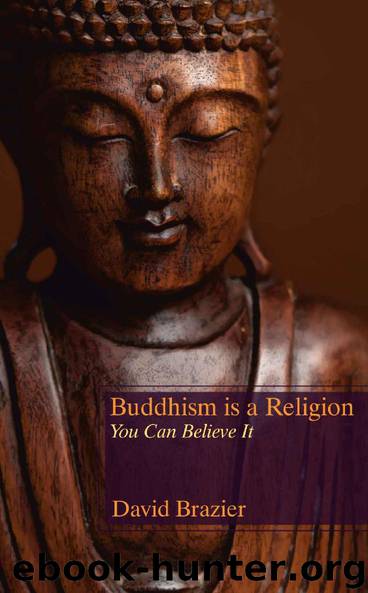
Buddhism is a Religion: You Can Believe It by David Brazier
Author:David Brazier [Brazier, David]
Language: eng
Format: epub
Publisher: Woodsmoke Press
Published: 2014-12-19T23:00:00+00:00
The Here and Now Fallacy
In the modern definition of mindfulness one often sees references to living in the here and now or being aware in the present moment. This is often associated with increasing satisfaction in one's embodiedness. The Buddha, however, does not praise being in the present moment as something to cherish in itself and does not understand a person to be identical with their body. When the Buddha speaks of attending to what is present it is so that one can pass beyond attachment to it and arrive at spiritual liberation. In any case, it is clear that Buddha was not always paying attention to the here and now.
Earlier in this chapter I referred to the Mahaparinibbana Sutta. The idea that Buddhism is a kind of continuous alertness is confounded by the story in that text to the effect that Buddha was once so deep in meditation that he did not notice a thunderstorm that was going on around him that was so severe that two farmers were killed by it. If the Buddha could be so unaware of his immediate surroundings while still awake, one can hardly think that being acutely conscious of the here and now is the whole aim. Nor is this treated as a lapse: it is cited to show approvingly how deeply the Buddha enters into trance states in which here and now awareness is excluded.
There is a small group of utterances of Buddha that go under the name Bhaddekaratta. These are sometimes used as a basis for justification of the idea that Buddhism is about dwelling in the present moment. The term bhadde-karatte, means “to have had a good night”. Various translators have wrestled with the meaning of this, but it seems a reasonable conjecture that it is the Buddha's way of advocating that others do what he did. His own spiritual awakening came in the course of a night of reflection. He is saying “I had a good night once, now you can have yours.” The core of these utterances is a verse passage that gives the following message:
Download
This site does not store any files on its server. We only index and link to content provided by other sites. Please contact the content providers to delete copyright contents if any and email us, we'll remove relevant links or contents immediately.
The Way of Zen by Alan W. Watts(6565)
Ego Is the Enemy by Ryan Holiday(5365)
The Art of Happiness by The Dalai Lama(4103)
The Book of Joy by Dalai Lama(3951)
Why Buddhism is True by Robert Wright(3429)
Spark Joy by Marie Kondo(3278)
Shift into Freedom by Loch Kelly(3172)
Happiness by Matthieu Ricard(3027)
A Monk's Guide to a Clean House and Mind by Shoukei Matsumoto(2894)
The Lost Art of Good Conversation by Sakyong Mipham(2632)
The Meaning of the Library by unknow(2543)
The Unfettered Mind: Writings from a Zen Master to a Master Swordsman by Takuan Soho(2278)
The Third Eye by T. Lobsang Rampa(2245)
Anthology by T J(2189)
Red Shambhala by Andrei Znamenski(2168)
The Diamond Cutter by Geshe Michael Roach(2046)
Thoughts Without A Thinker: Psychotherapy from a Buddhist Perspective by Epstein Mark(1997)
Twilight of Idols and Anti-Christ by Friedrich Nietzsche(1877)
Advice Not Given by Mark Epstein(1868)
